Go to page content
Leak sealing during operation. Man performs sealing with clamps.

Test

Our experienced technicians seal valves, flanges and piping systems on-site while the plant is running. With experience dating back to 1979, we perform safe and effective sealing of steam, hydrocarbons and a variety of chemicals on various equipment types and geometries. This means less downtime, lower emissions and safer operation.

More about the service

  • Yes, sealing during operation is a technically demanding operation and requires qualified professionals who conduct thorough risk assessments before implementation.
  • The method is not necessarily suitable for all types of faults and assessment must be made based on the nature of the leak, pressure, temperature and condition of the component.
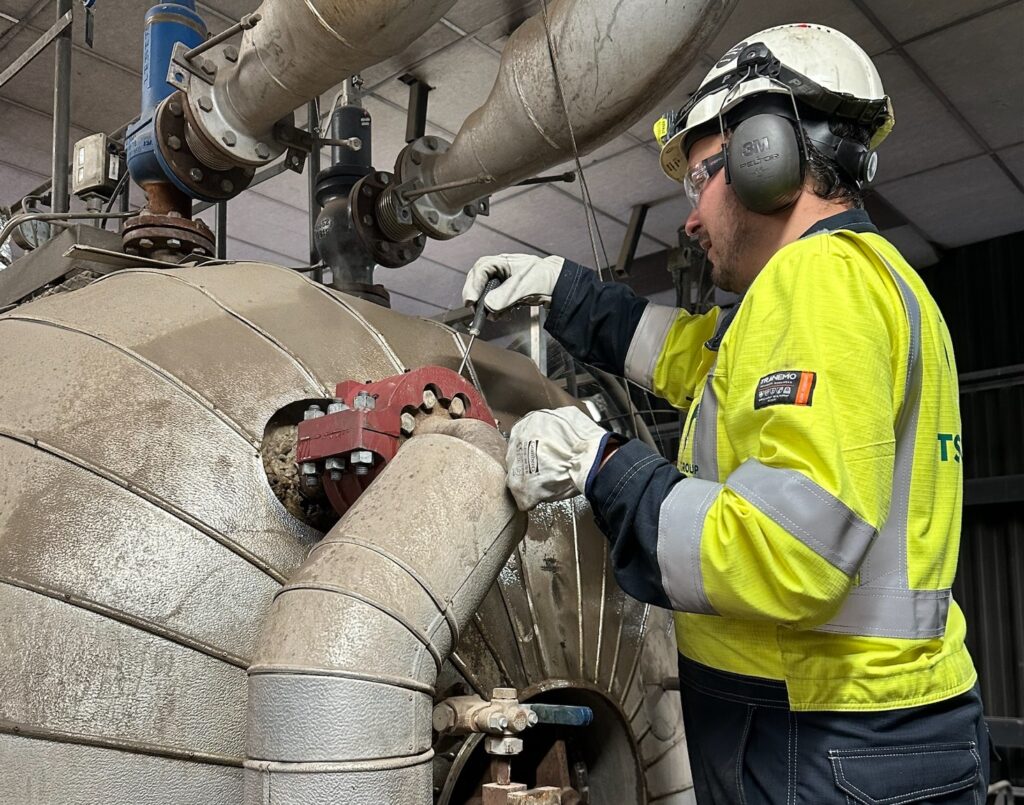
Leak sealing during operation involves sealing leaks in process plants, for example in pipes, valves, flanges or heat exchangers without stopping production.

The service is suitable for all types of industrial facilities – onshore or offshore – where there are pipes, valves, flanges, heat exchangers or other equipment that can leak and where production downtime is costly or undesirable.

TS Site Services can seal leaks in pipes, flanges, heat exchangers, rotating equipment, welded joints, bolts/grooves, etc.

We have experience with, but are not limited to, steam, gas, liquids, hydrocarbons, as well as over 300 different chemicals.

The service can be used on systems with temperatures from minus 30 degrees Celsius to plus 600 degrees Celsius, and pressures up to 350 bar.

We can deliver the service throughout the country, both onshore and offshore, regardless of the location of the facility or installation. TS Site Services also has experience in delivering internationally, and we take on assignments outside Norway's borders.

We do our utmost to mobilize quickly and flexibly, and the service is part of our maintenance and modification offerings that cover both on- and offshore.

  • TS Site Services can perform the sealing using sealing clamps based on precise measurements and 3D designs or by injecting sealants directly into the leak area.
  • Before work begins, risks and a plan for sealing are assessed. The work is always carried out by experienced technicians with the right expertise.

After sealing, the work is quality assured through testing and inspection to verify that the leak has been stopped and the seal is secure and stable. We deliver this as a standard procedure.

  • It eliminates the need for production downtime, saving time and costs.
  • It reduces product and energy losses, and reduces emissions to the environment.
  • It extends the life of the plant's components.

Do you have a question?

Jørgen Rui

Jørgen Rui

Operations Manager

See other services

keyboard_arrow_up